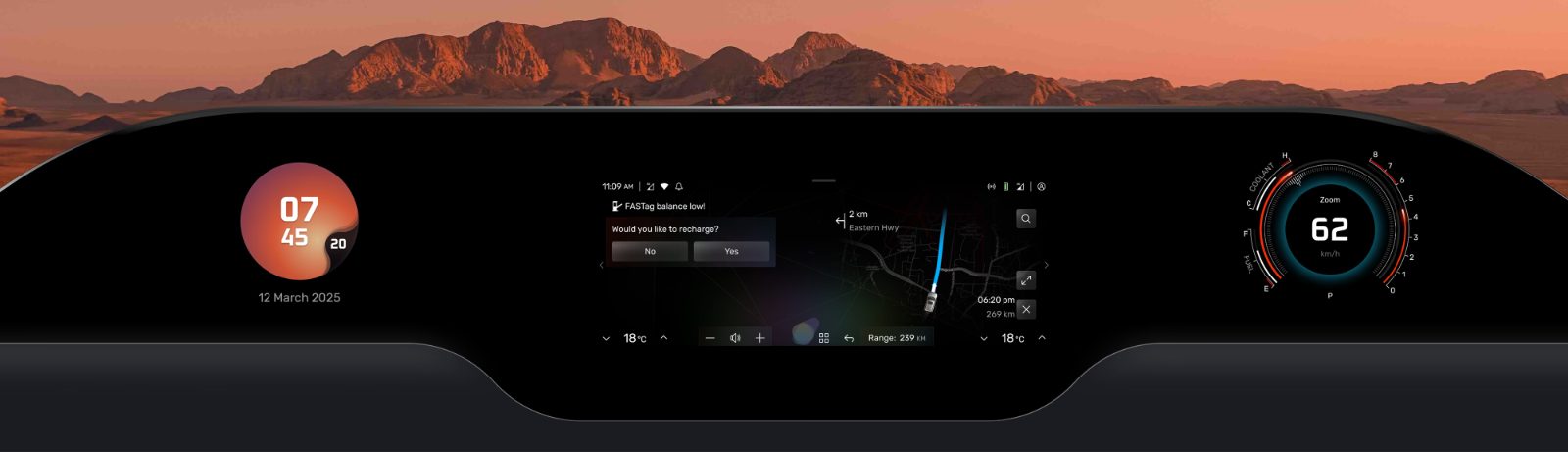
Designing for Context, Not Commands

Designing for Context, Not Commands

MAIA : An Ambient Intelligence System for Automotive Experiences


MAIA : An Ambient Intelligence System


for Automotive Experiences


Role

Role

Role

Led end-to-end research and design, translating contextual insights into a proactive, ambient interaction system.

Led end-to-end research and design, translating contextual insights into a proactive, ambient interaction system.

Team

Team

Team

Collaborated across design, research, and engineering to align user intent with technical execution.


Collaborated across design, research, and engineering to align user intent with technical execution.


Timeline

Timeline

Timeline

4 weeks

4 weeks

Context

Context

Context

Mahindra’s existing HMI ecosystem operates across multiple vehicles without a unified interaction framework, resulting in fragmented user experiences and inconsistent design patterns. To address this, a new platform - UI Rise was introduced to establish a common design system across the product line.

However, while the platform standardizes interface structure, it continues to rely on manual feature discovery within an inherently attention-constrained driving environment. This creates a critical gap: as system complexity increases, the cognitive effort required to access functionality rises proportionally.

In response, a cross-functional team of designers was tasked with rethinking the interaction model - shifting from static, feature-based access to a more context-aware and intuitive experience layer.

Mahindra’s existing HMI ecosystem operates across multiple vehicles without a unified interaction framework, resulting in fragmented user experiences and inconsistent design patterns. To address this, a new platform - UI Rise was introduced to establish a common design system across the product line.

However, while the platform standardizes interface structure, it continues to rely on manual feature discovery within an inherently attention-constrained driving environment. This creates a critical gap: as system complexity increases, the cognitive effort required to access functionality rises proportionally.

In response, a cross-functional team of designers was tasked with rethinking the interaction model - shifting from static, feature-based access to a more context-aware and intuitive experience layer.

Problem Statement - Understanding the Intelligence Gap

Problem Statement - Understanding the Intelligence Gap

Problem Statement - Understanding the Intelligence Gap

As vehicles become software-defined, their capabilities expand - but their interaction models remain static resulting in underutilized features and fragmented experiences.

Interfaces continue to rely on explicit user initiation in environments defined by limited attention and constant change, leading to a disconnect between what the system can do and what the user is able to access in the moment. The problem is not the absence of functionality, but the inability of current systems to align capability with context under real-world conditions.


As vehicles become software-defined, their capabilities expand - but their interaction models remain static resulting in underutilized features and fragmented experiences.

Interfaces continue to rely on explicit user initiation in environments defined by limited attention and constant change, leading to a disconnect between what the system can do and what the user is able to access in the moment. The problem is not the absence of functionality, but the inability of current systems to align capability with context under real-world conditions.


Hidden Functionality

Hidden Functionality

Critical features are embedded deep within system layers

Critical features are embedded deep within system layers

Manual Discoverability


Manual Discoverability


Increasing levels of automation, yet user goes looking for functionality.

Increasing levels of automation, yet user goes looking for functionality.

Fragmented Attention


Interaction demands split focus between driving and the interface, reducing situational awareness.

Interaction demands split focus between driving and the interface, reducing situational awareness.

Cognitive Overload


Dozens of assistive features are presented without prioritization.

How might we move from feature discovery to contextual orchestration in automotive HMI?


How might we move from feature discovery to contextual orchestration in automotive HMI?


How might we move from feature discovery to contextual orchestration in automotive HMI?


Context Harvesting

Context Harvesting

Context Harvesting

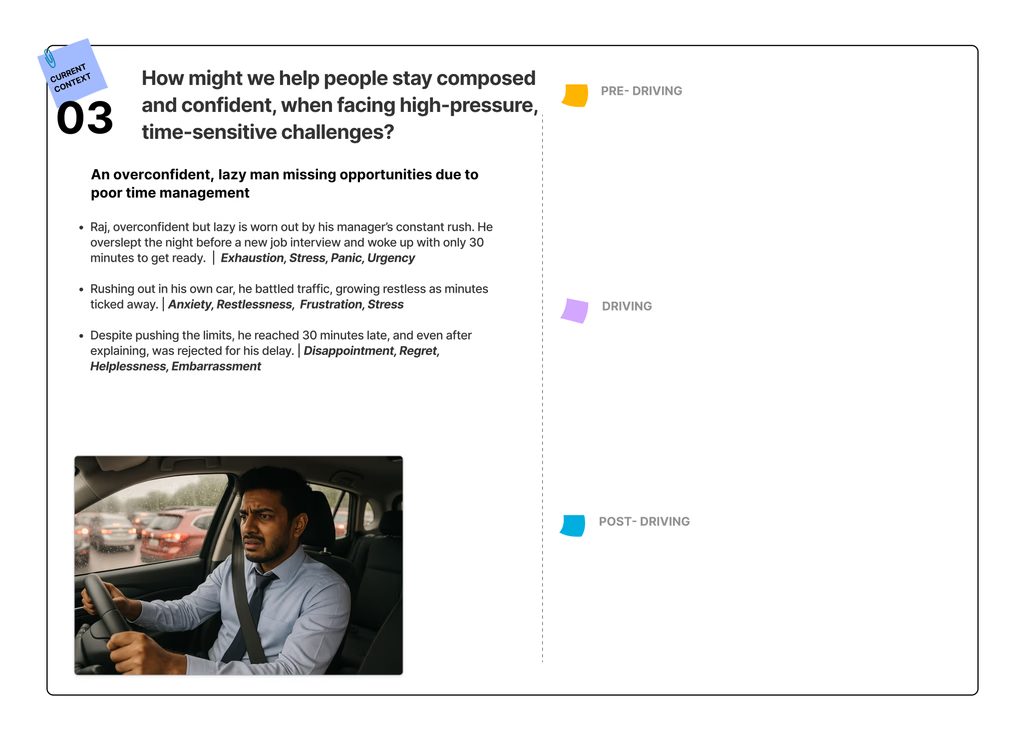
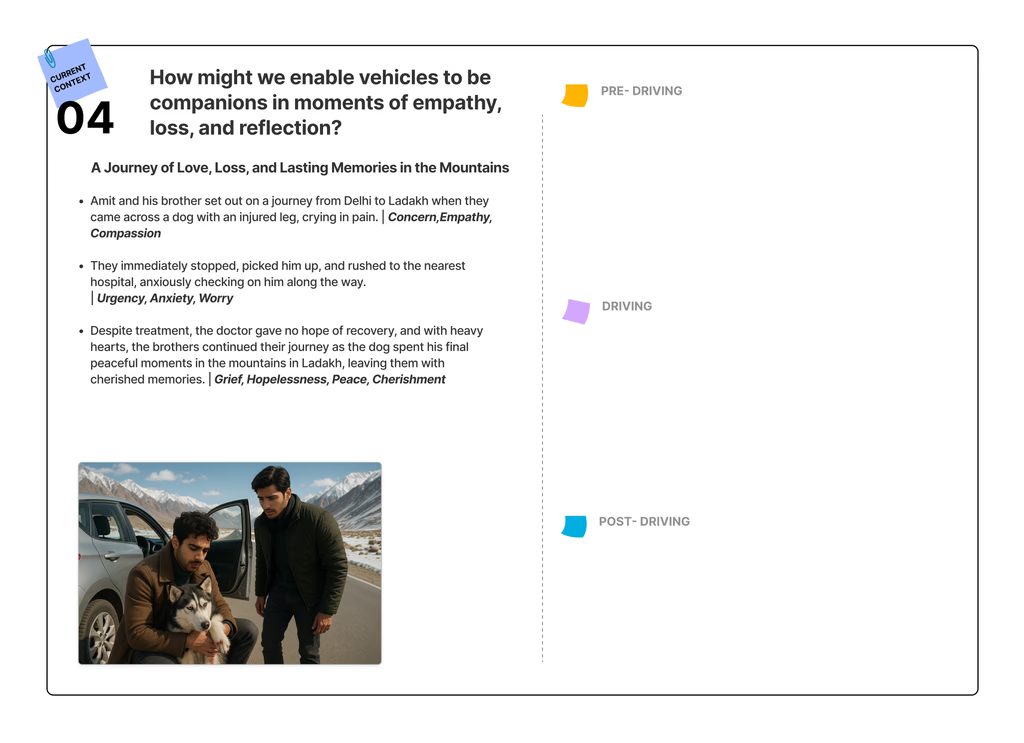
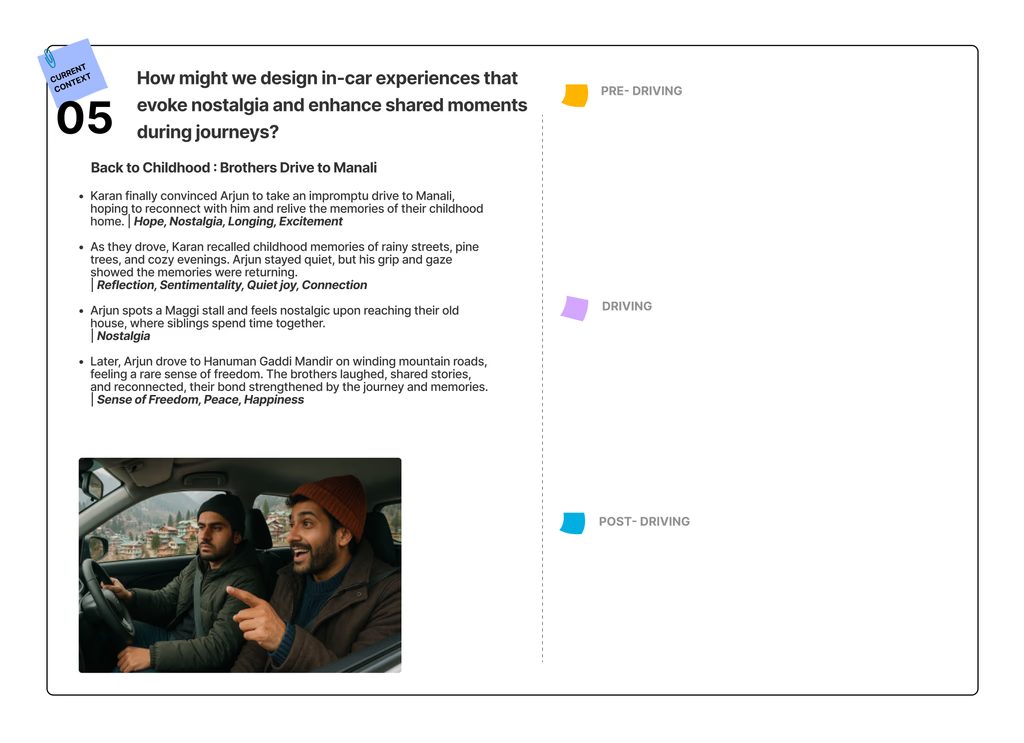
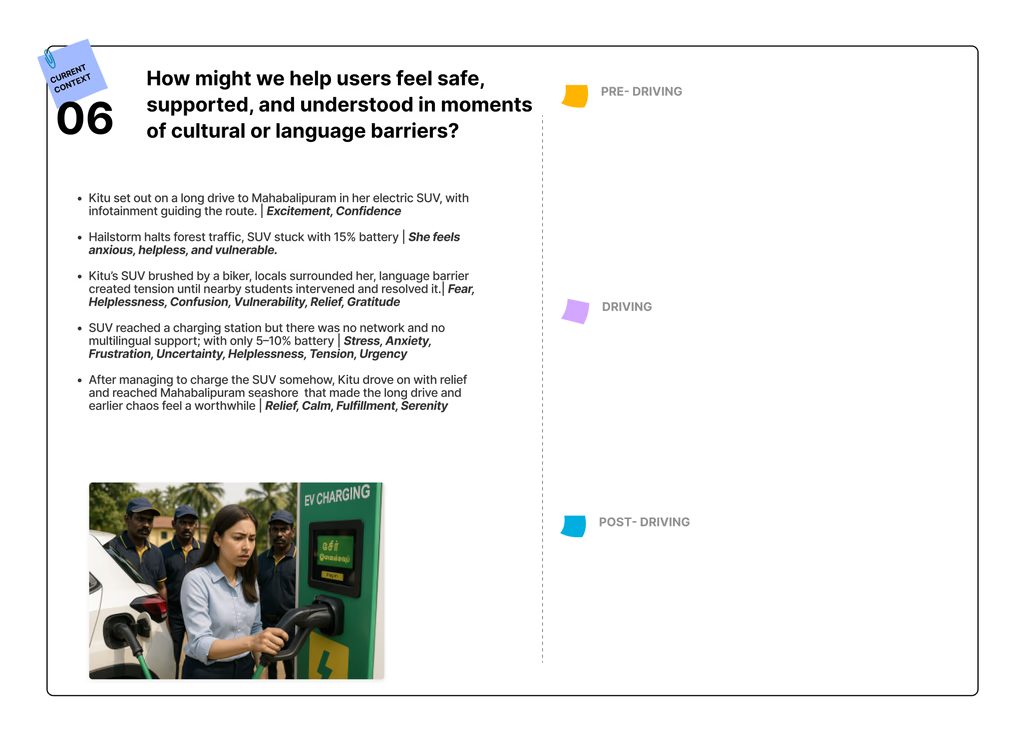
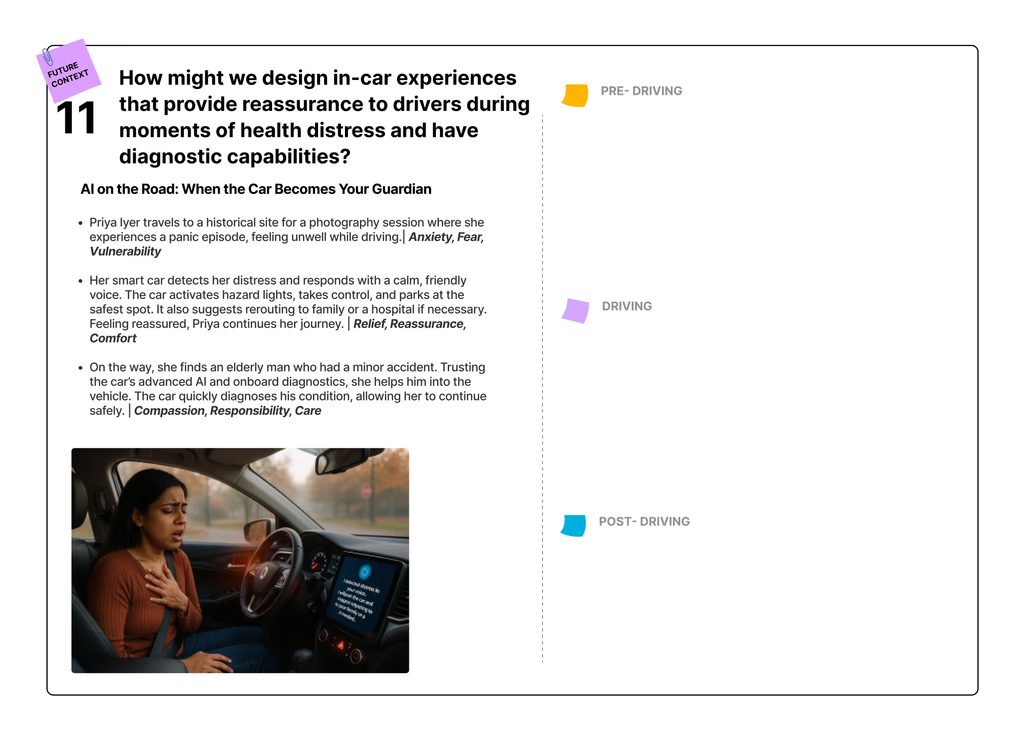
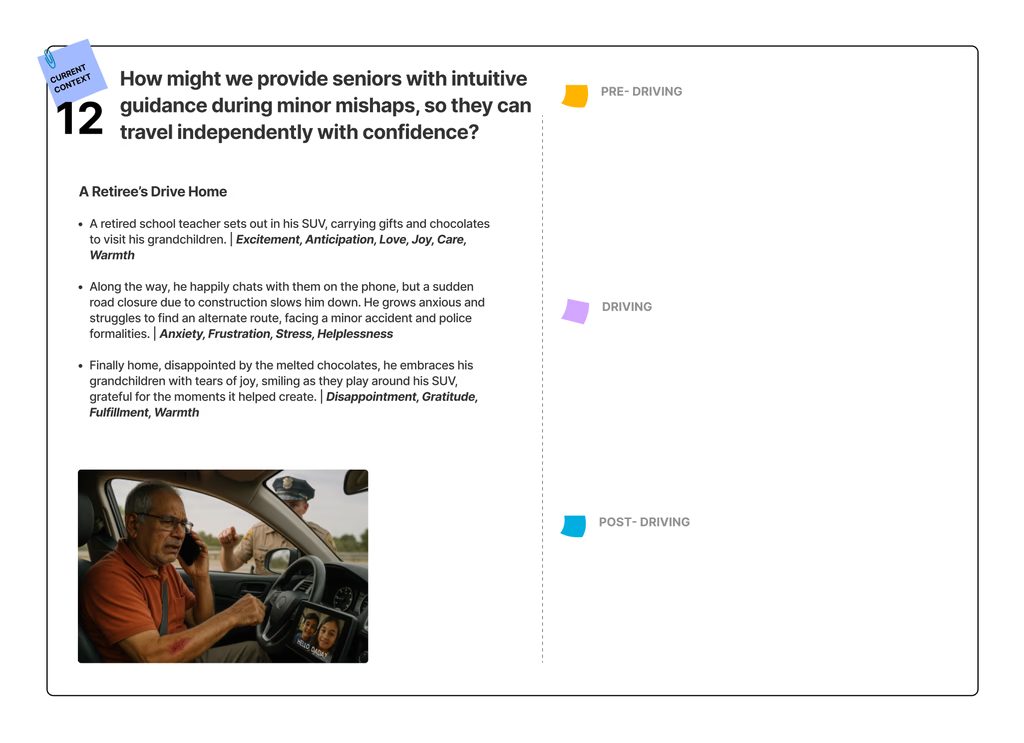
Rather than studying isolated driving tasks, the research focused on understanding complex, real-world mobility situations where context shapes behavior, attention, and decision-making. Through story-driven interviews, we captured emotionally rich driving narratives revealing behavioral patterns, breakdown moments, latent needs.


Rather than studying isolated driving tasks, the research focused on understanding complex, real-world mobility situations where context shapes behavior, attention, and decision-making. Through story-driven interviews, we captured emotionally rich driving narratives revealing behavioral patterns, breakdown moments, latent needs.


A key insight from this process was that: the car is not just a machine - it is a social and emotional environment. Across scenarios, the vehicle emerged as:

A key insight from this process was that: the car is not just a machine - it is a social and emotional environment. Across scenarios, the vehicle emerged as:

Environmental
Environmental

Real World Context

Driving contexts are complex and situational (pilgrimages, rallies, funerals), where environment heavily shapes needs and system expectations.

Driving contexts are complex and situational (pilgrimages, rallies, funerals), where environment heavily shapes needs and system expectations.

Behavioral
Behavioral

Behavioral Patterns

User behavior shifts with emotional and physical states like fatigue, urgency, distraction, and responsibility.

User behavior shifts with emotional and physical states like fatigue, urgency, distraction, and responsibility.

Social
Social

Shared Context

Mobility is deeply social - driven by family dynamics, group interactions, cultural norms, and shared experiences.

Mobility is deeply social - driven by family dynamics, group interactions, cultural norms, and shared experiences.

Co-Creating Context

Co-Creating Context

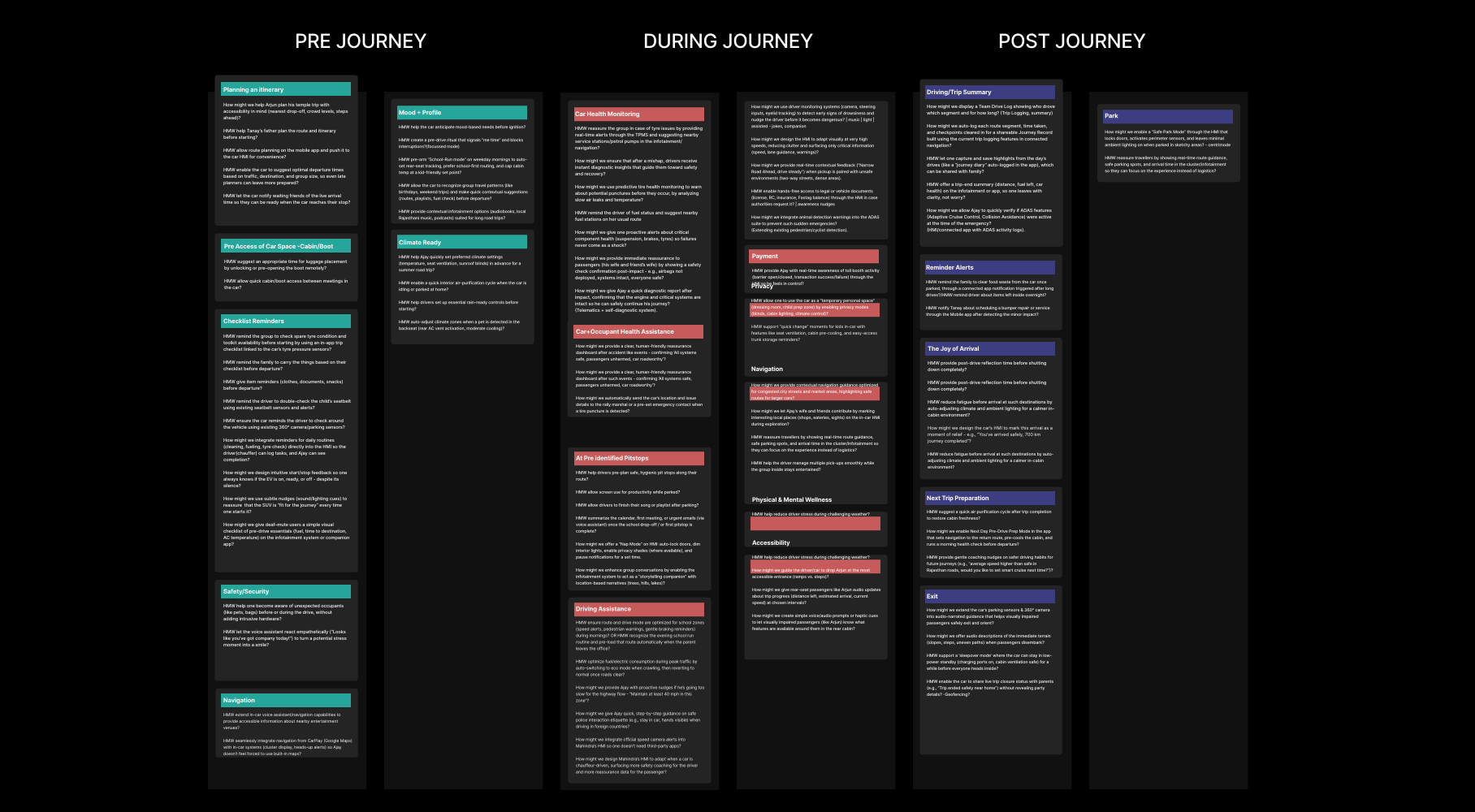
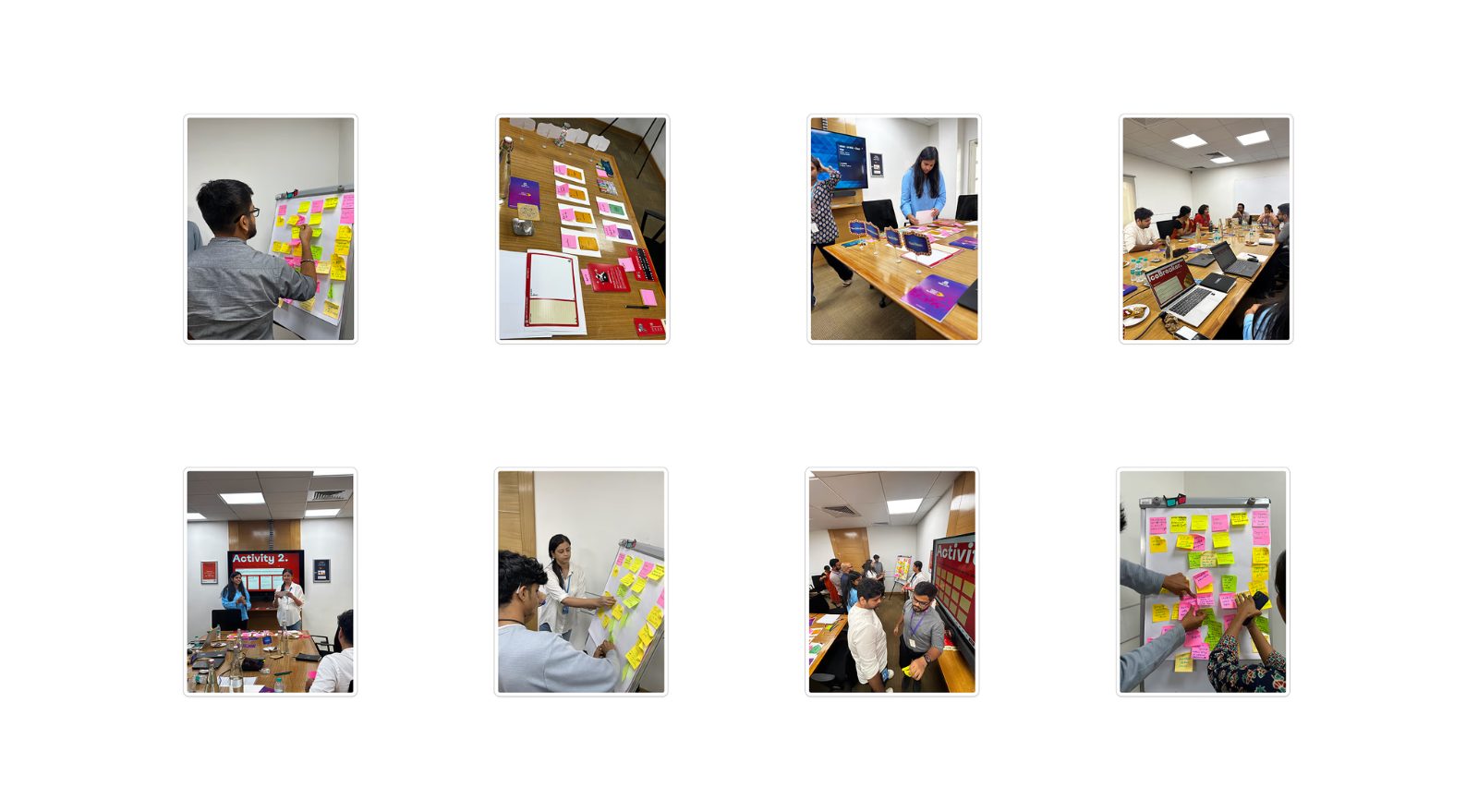
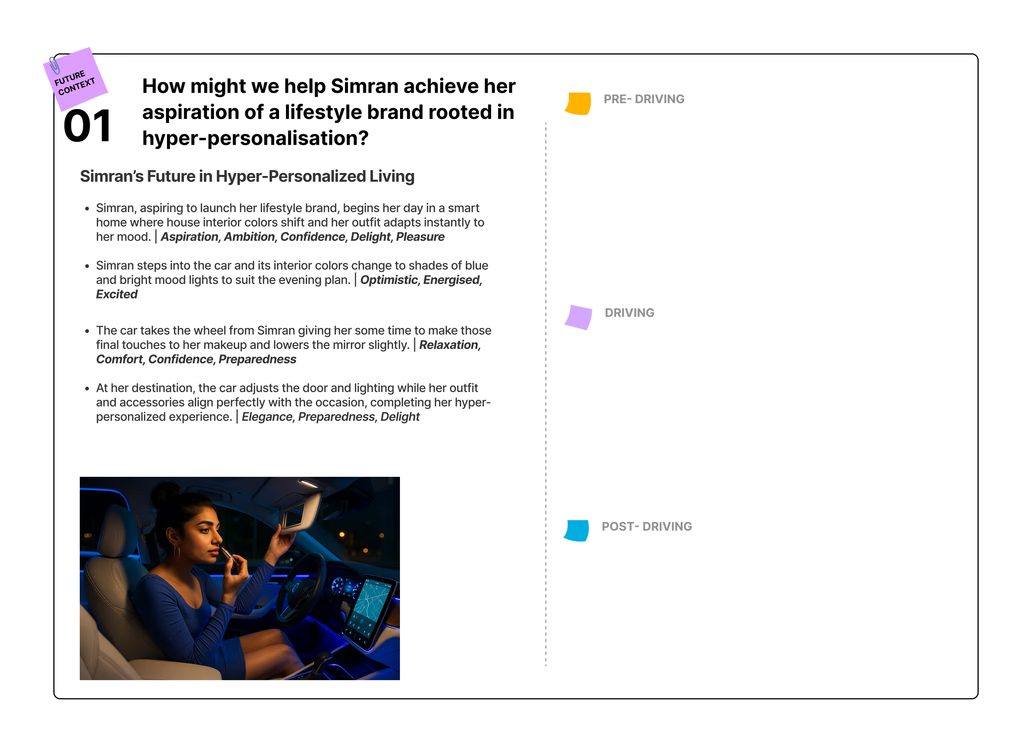
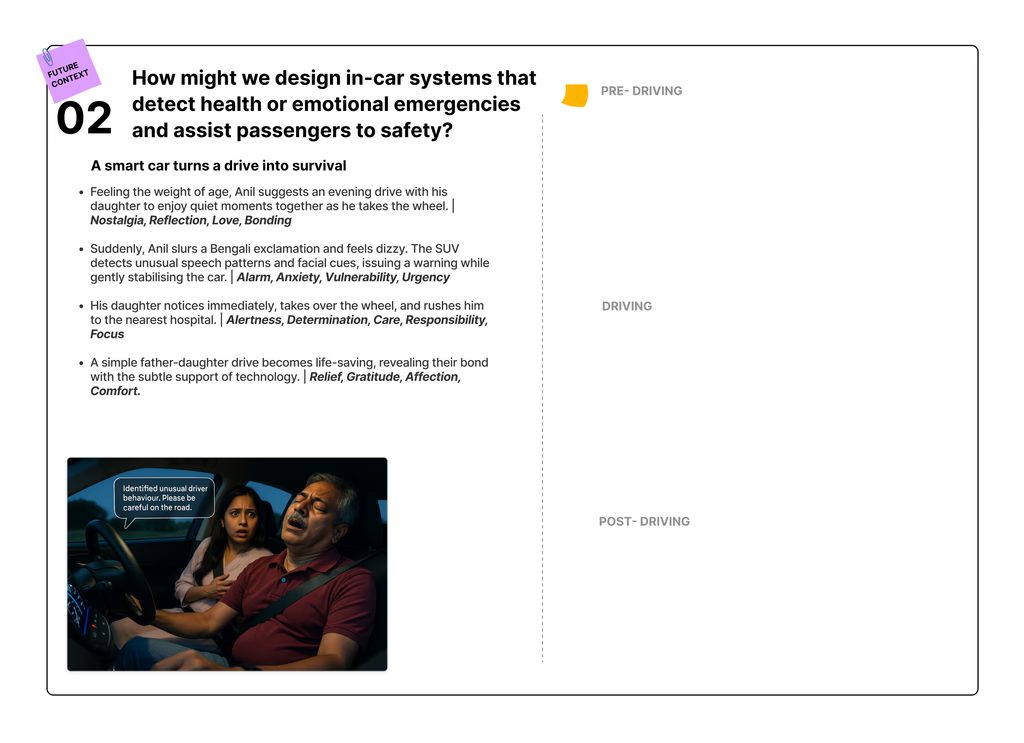
To move beyond observed behavior, I designed and facilitated structured narrative workshops which helped us capture edge cases and culturally grounded behaviors. The outcome was not a set of ideas, but a rich dataset of contextual narratives. Participants constructed:

  • present-day driving scenarios

  • speculative future contexts


To move beyond observed behavior, I designed and facilitated structured narrative workshops which helped us capture edge cases and culturally grounded behaviors. The outcome was not a set of ideas, but a rich dataset of contextual narratives. Participants constructed:

  • present-day driving scenarios

  • speculative future contexts


A Different Lens on Mobility

A Different Lens on Mobility

A key insight from this process was that: the car is not just a machine - it is a social and emotional environment. Across scenarios, the vehicle emerged as:

A key insight from this process was that: the car is not just a machine - it is a social and emotional environment. Across scenarios, the vehicle emerged as:

Private Escape
Private Escape

Inner world takes priority

The vehicle becomes a personal retreat where users seek calm, control, and a break from external pressures.

Shared Experience
Shared Experience

Together along the journey.


Journeys are shared - interactions, conversations, and group needs shape attention and decisions.

Environment
Environment

Context drives behavior

Behavior is shaped by context - surroundings, urgency, and purpose influence how users engage with the system.

Translating Context into Product Strategy

Translating Context into Product Strategy

Translating Context into Product Strategy

We synthesized narrative-driven insights into clusters of recurring behavioral signals, revealing patterns in user needs, emotional states, and contextual triggers across diverse mobility situations.

We synthesized narrative-driven insights into clusters of recurring behavioral signals, revealing patterns in user needs, emotional states, and contextual triggers across diverse mobility situations.

Cross-Functional Alignment

We conducted collaborative workshops with design and engineering leadership at Mahindra to validate opportunity areas against technical feasibility, system constraints, and product vision.

We conducted collaborative workshops with design and engineering leadership at Mahindra to validate opportunity areas against technical feasibility, system constraints, and product vision.

Critical features are embedded deep within system layers

Critical features are embedded deep within system layers

Structuring Ambiguous Narratives

Structuring Ambiguous Narratives

Identifying Recurring Patterns

Identifying Recurring Patterns

Increasing levels of automation, yet user goes looking for functionality.

Increasing levels of automation, yet user goes

looking for functionality.

Interaction demands split focus between driving and the interface, reducing situational awareness.

Aligning with Engineering
Feasibility

Interaction demands split focus between driving and the interface, reducing situational awareness.

Aligning with Engineering
Feasibility

Prioritizing high-impact interventions


Prioritizing high-impact interventions


Dozens of assistive features are presented without prioritization.

Dozens of assistive features are presented without prioritization.

Signal Extraction
Signal Extraction
Identified patterns across stories

Recurring Signals

Recurring behaviors, breakdown moments, and unmet needs surfaced consistently across diverse mobility scenarios.

Created thematic clusters

Together along the journey.


Patterns were synthesized into broader themes, grouping related signals to reveal deeper opportunity areas.

Grouped HMWs

Opportunity Framing

Themes were translated into focused “How Might We” questions to guide solution exploration and design direction.

Identified patterns across stories

Recurring Signals

Recurring behaviors, breakdown moments, and unmet needs surfaced consistently across diverse mobility scenarios.

Created thematic clusters

Thematic Synthesis

Patterns were synthesized into broader themes, grouping related signals to reveal deeper opportunity areas.

Grouped HMWs

Grouped HMWs

Opportunity Framing

Themes were translated into focused “How Might We” questions to guide solution exploration and design direction.

Context-to-Feature Translation

“Each opportunity cluster was translated into potential HMI capabilities, mapping contextual triggers to relevant feature interventions.”

“Each opportunity cluster was translated into potential HMI capabilities mapping contextual triggers to relevant feature interventions.”

Prioritization Framework

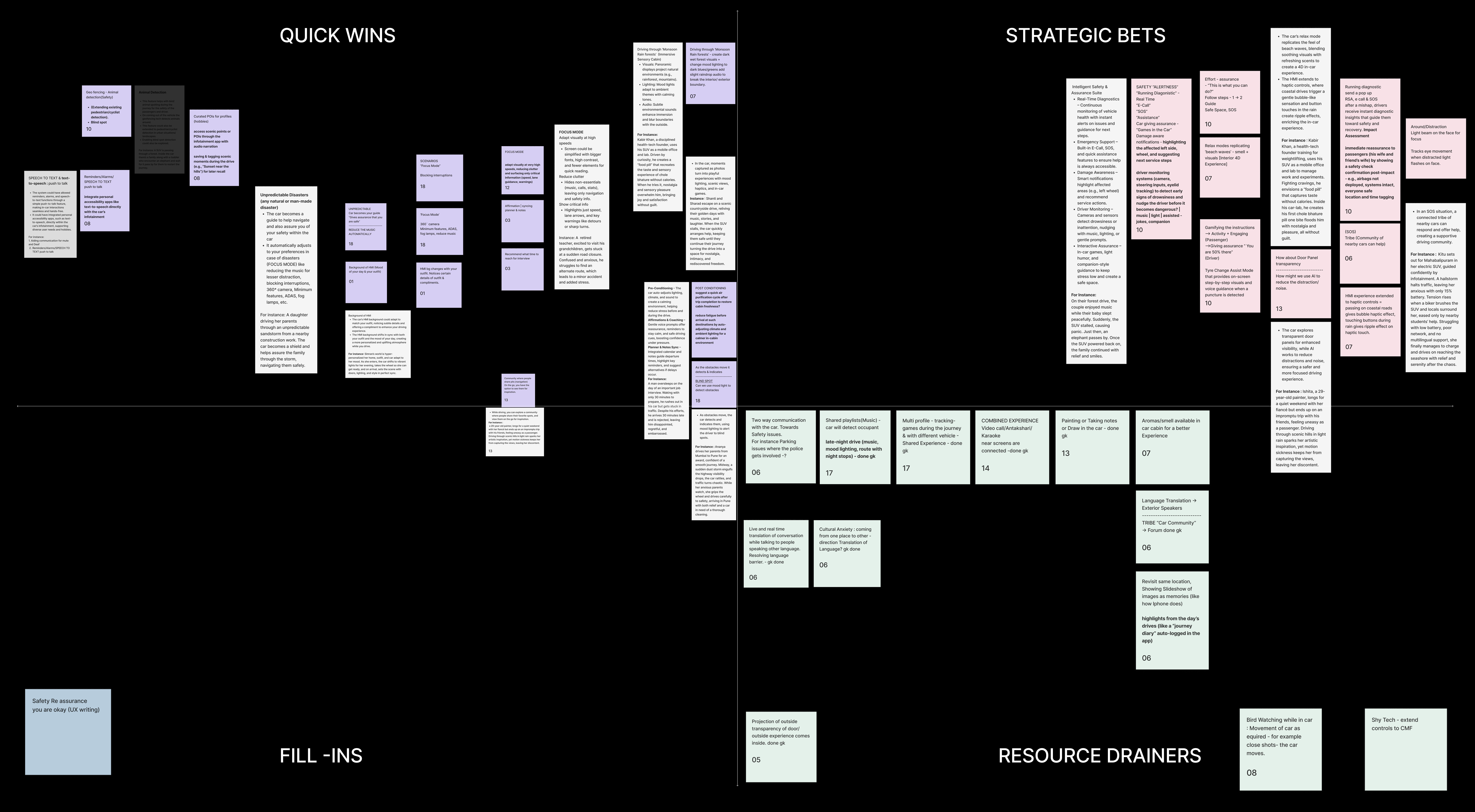
To strategically focus development efforts, all opportunity areas were mapped against: Impact vs Effort. The framework categorized initiatives into

To strategically focus development efforts, all opportunity areas were mapped against: Impact vs Effort. The framework categorized initiatives into

Trend Scan & Expert Consultation

A rapid trend scan and expert consultation with automotive specialists was conducted to:

  • validate emerging opportunity areas

  • stress-test assumptions

  • align with industry trends

  • identify long-term strategic directions

A rapid trend scan and expert consultation with automotive specialists was conducted to:

  • validate emerging opportunity areas

  • stress-test assumptions

  • align with industry trends

  • identify long-term strategic directions

Product Evolution Trends

Market Signals

  • Align with industry trends

  • Validate emerging opportunity areas

  • Stress-test assumptions


Engineering Reality Check

Feasibility Constraints

  • Software-first differentiation

  • Validate emerging opportunity areas

  • Stress-test assumptions


Business Model Shift

Revenue Shift

  • Subscription-based features

  • Servitization

  • Post-purchase value


Product Evolution Trends

Market Signals

  • Align with industry trends

  • Validate emerging opportunity areas

  • Stress-test assumptions


Engineering Reality Check

Feasibility Constraints

  • Software-first differentiation

  • Validate emerging opportunity areas

  • Stress-test assumptions


Business Model Shift

Revenue Shift

  • Subscription-based features

  • Servitization

  • Post-purchase value


Translating Intelligence into HMI

Translating Intelligence into HMI

Translating Intelligence into HMI

UX vs Aesthetic Trade-off

UX vs Aesthetic Trade-off

Designing for an attention-constrained environment revealed a fundamental tension between usability and visual richness.

  • Reducing interaction effort necessitated visual restraint

  • Increasing aesthetic complexity risked compromising cognitive efficiency

As a result, aesthetics were intentionally deprioritized - serving as an enhancement layer, not a primary driver of interaction.

Opportunity areas were translated into context-aware interaction models, mapped across 20 real-world driving scenarios and synthesized into three core behavioral journeys. These storyboards helped us design not just interactions, but adaptive behaviors over time. One narrative was prioritized to deeply explore how intelligence should surface within the driving experience


Opportunity areas were translated into context-aware interaction models, mapped across 20 real-world driving scenarios and synthesized into three core behavioral journeys. These storyboards helped us design not just interactions, but adaptive behaviors over time. One narrative was prioritized to deeply explore how intelligence should surface within the driving experience


Seamless Everyday Intelligence

Intelligence should feel ambient, not interruptive

Intelligence should feel ambient, not interruptive

  • Proactive suggestions

  • Subtle nudges

  • Low cognitive load

  • Proactive suggestions

  • Subtle nudges

  • Low cognitive load

Safety-Aware System
Safety-Aware System
Safety-Aware System

The system shifts from assistant to co-driver

The system shifts from assistant to co-driver

  • Drowsiness Detection

  • Passenger Comfort

  • Continuous Upgrades

  • Drowsiness Detection

  • Passenger Comfort

  • Continuous Upgrades

Lifestyle Experience

The car becomes a companion

The car becomes a companion

  • Subscription-based features

  • Servitization

  • Post-purchase value

  • Subscription-based features

  • Servitization

  • Post-purchase value

Interaction Strategy

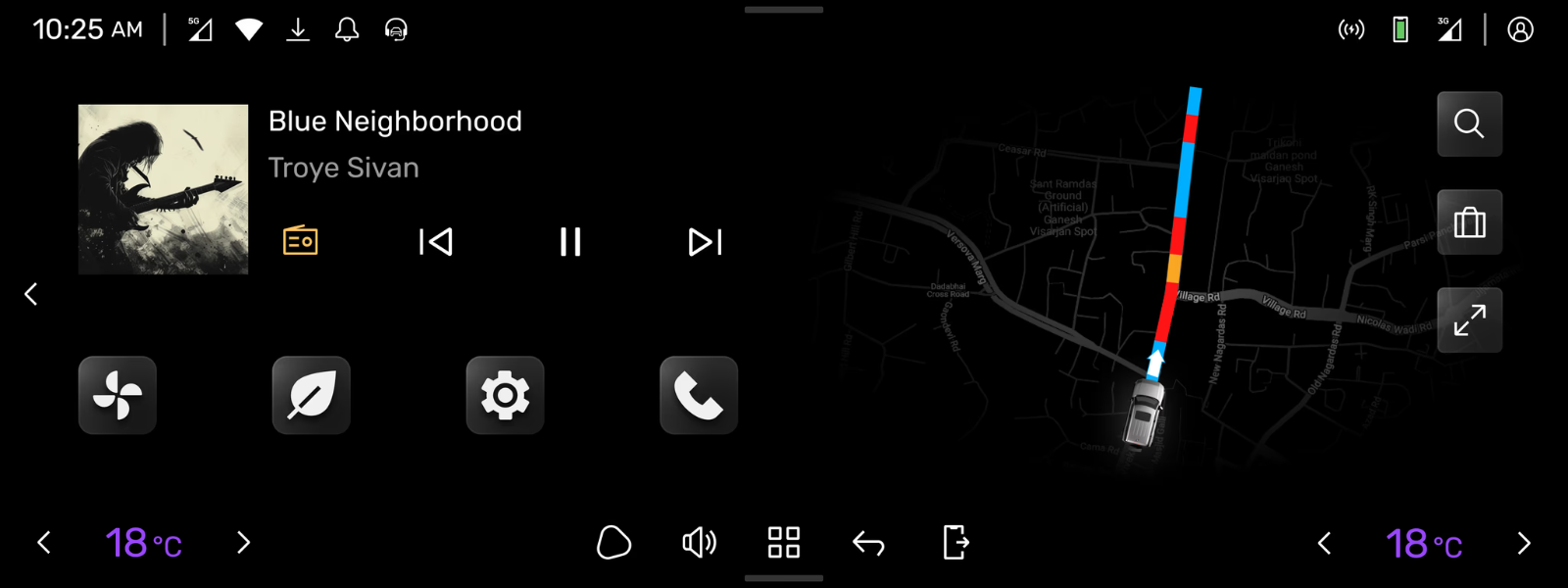
MAIA was designed as an adaptive interaction layer, not a standalone feature - embedded within the system to surface intelligence proactively.

The focus was on defining:

  • where assistance should appear

  • when it should intervene

  • how it should behave across states

The goal was to integrate intelligence seamlessly, without disrupting primary driving tasks.


MAIA was designed as an adaptive interaction layer, not a standalone feature - embedded within the system to surface intelligence proactively.

The focus was on defining:

  • where assistance should appear

  • when it should intervene

  • how it should behave across states

The goal was to integrate intelligence seamlessly, without disrupting primary driving tasks.


Design Approach

Design Approach

Design Approach

The process emphasized speed, structure, and continuous alignment:

This ensured the system evolved coherently as complexity increase


The process emphasized speed, structure, and continuous alignment:

This ensured the system evolved coherently as complexity increase


Context-driven benchmarking

Context-driven benchmarking

Grounded in real-world context, not abstraction.Ensures decisions stay anchored to actual driving scenarios.

Grounded in real-world context, not abstraction.Ensures decisions stay anchored to actual driving scenarios.

Mapping relationships between features and driving scenarios

Mapping relationships between features and driving scenarios

Clear relationships between features and use-cases. Ensures intelligence is triggered with intent, not redundancy.

Clear relationships between features and use-cases. Ensures intelligence is triggered with intent, not redundancy.

Speed prioritized to uncover direction early. Rapid iteration drives clarity over perfection.

Speed prioritized to uncover direction early. Rapid iteration drives clarity over perfection.

Rapid wireframing and iterative
prototyping

Rapid wireframing and iterative
prototyping

Continuous design tracking with strict version control


Continuous design tracking with strict version control


Rigor embedded in design evolution.
Maintains a single source of truth across teams and scale.

Rigor embedded in design evolution.
Maintains a single source of truth across teams and scale.

Behavioral Model of MAIA


Behavioral Model of MAIA


Behavioral Model of MAIA


MAIA’s interaction was defined through state-based behavior: These states governed:

Shifting the design from static UI to dynamic system behavior.


MAIA’s interaction was defined through state-based behavior: These states governed:

Shifting the design from static UI to dynamic system behavior.


Response Timing
Response Timing

Acts before the need arises.

Continuously interprets context to deliver timely interventions subtle, precise, and never disruptive

Interaction Hierarchy

Surfaces what matters, when it matters.

Dynamically prioritizes information and actions based on driver state, intent, and driving conditions.

Visual Feedback
Visual Feedback

Communicates without demanding attention.

Uses ambient, glanceable cues to inform and reassure keeping focus on the road, not the interface.

Dormant

Dormant

Dormant

Listening

Listening

Listening

Thinking

Thinking

Thinking

Speaking

Speaking

Speaking

UI

UI

UI

Multiple chrome-state explorations were conducted including:

  • blob/orb systems

  • linear intelligence patterns

  • mascot-based explorations

  • ambient visual states

Additional explorations included:

  • contextual widgets

  • loading states

  • error handling

Multiple chrome-state explorations were conducted including:

  • blob/orb systems

  • linear intelligence patterns

  • mascot-based explorations

  • ambient visual states


Additional explorations included:

  • contextual widgets

  • loading states

  • error handling

Blob/Orb Systems

Blob/Orb Systems

They create a soft, non-intrusive feedback layer - communicating change, attention, and intent without relying on rigid UI elements.

They create a soft, non-intrusive feedback layer - communicating change, attention, and intent without relying on rigid UI elements.

Linear intelligence patterns

Linear intelligence patterns

These patterns guide users through logic, progress, and decision pathways with clarity and predictability.

These patterns guide users through logic, progress, and decision pathways with clarity and predictability.

Mascot based explorations

Mascots act as expressive guides - making complex states more relatable, approachable, and emotionally engaging.

Mascots act as expressive guides - making complex states more relatable, approachable, and emotionally engaging.

Mascot based explorations

Ambient visual states


Ambient visual states


They provide continuous, low-attention feedback through motion, color, and light - enhancing awareness without distraction.

They provide continuous, low-attention feedback through motion, color, and light - enhancing awareness without distraction.

Dormant

Speaking

Speaking

Dormant/Listening

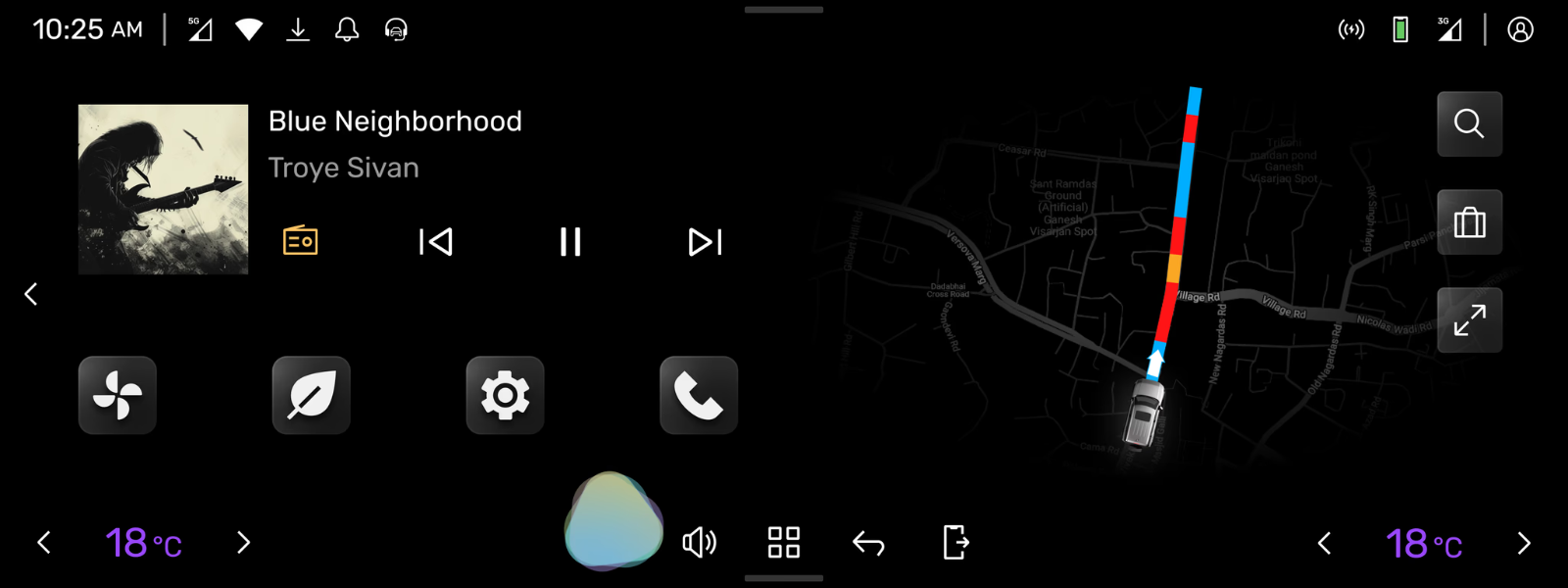
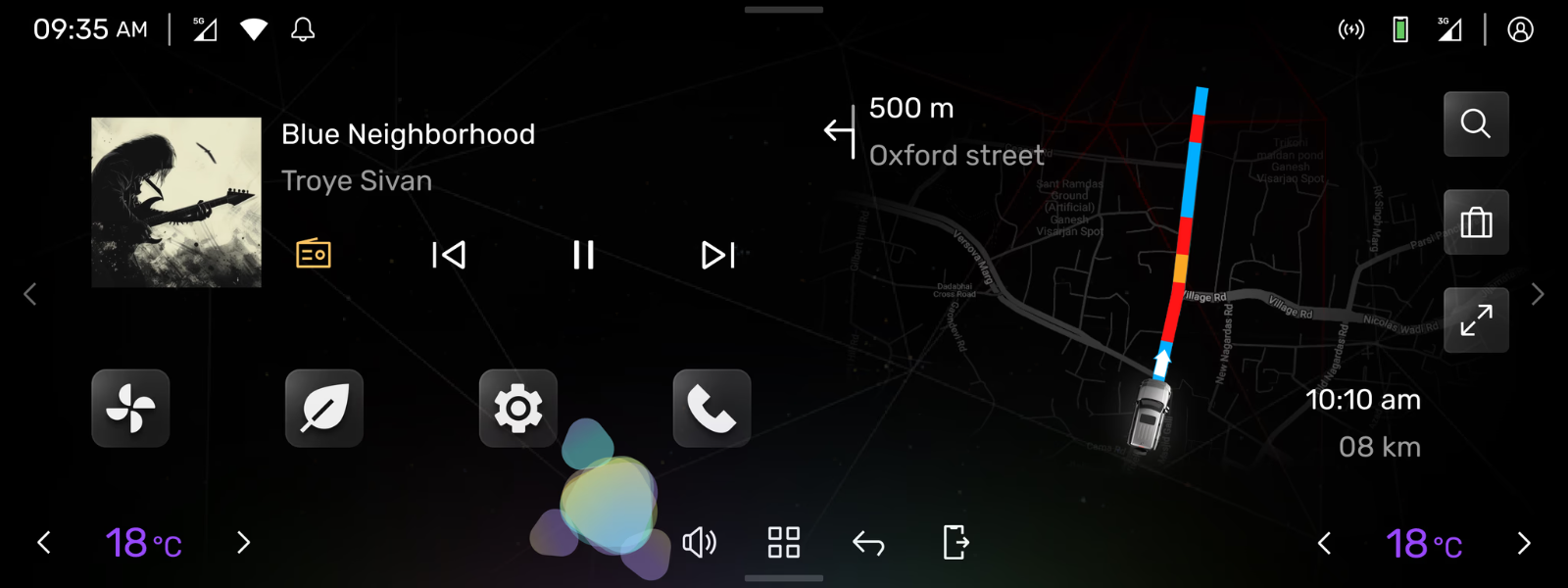
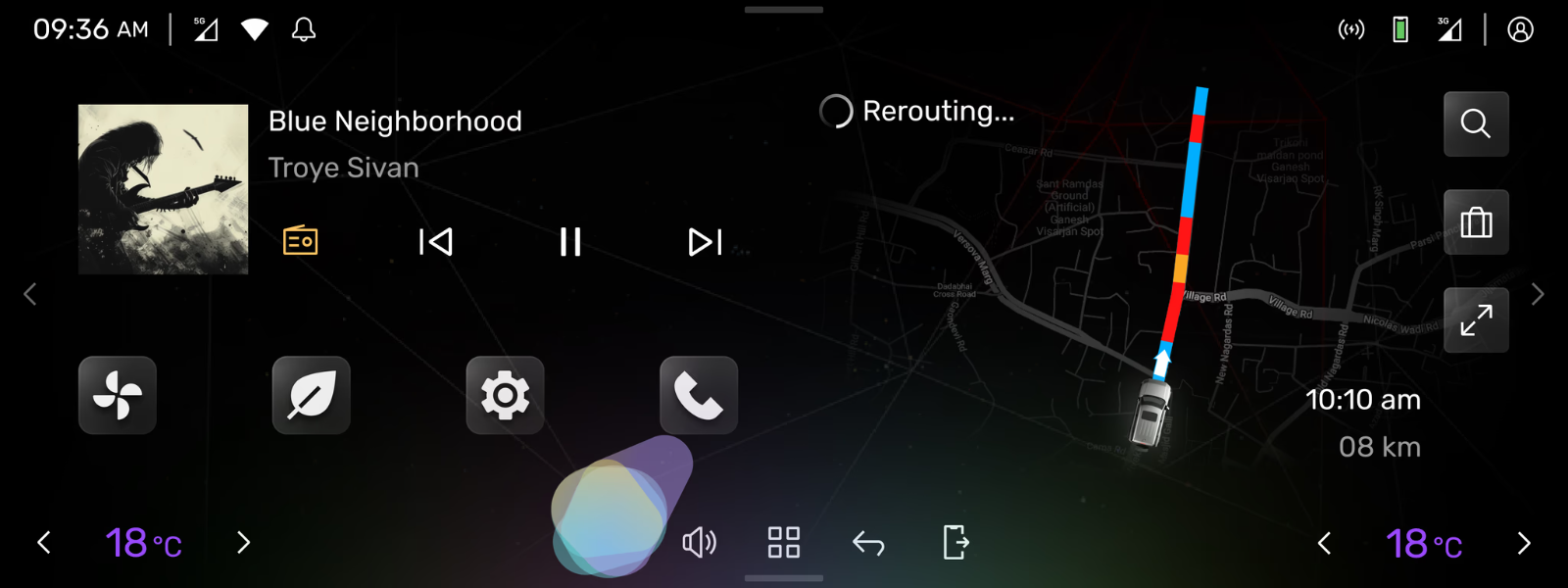
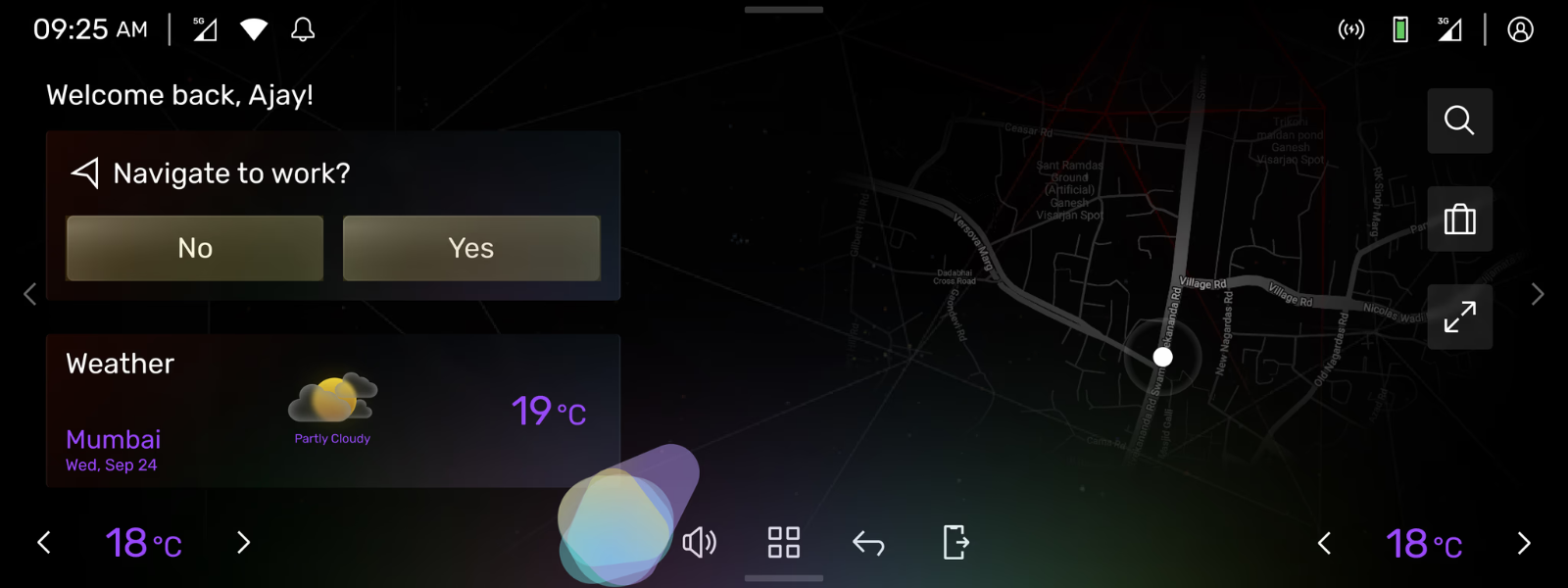
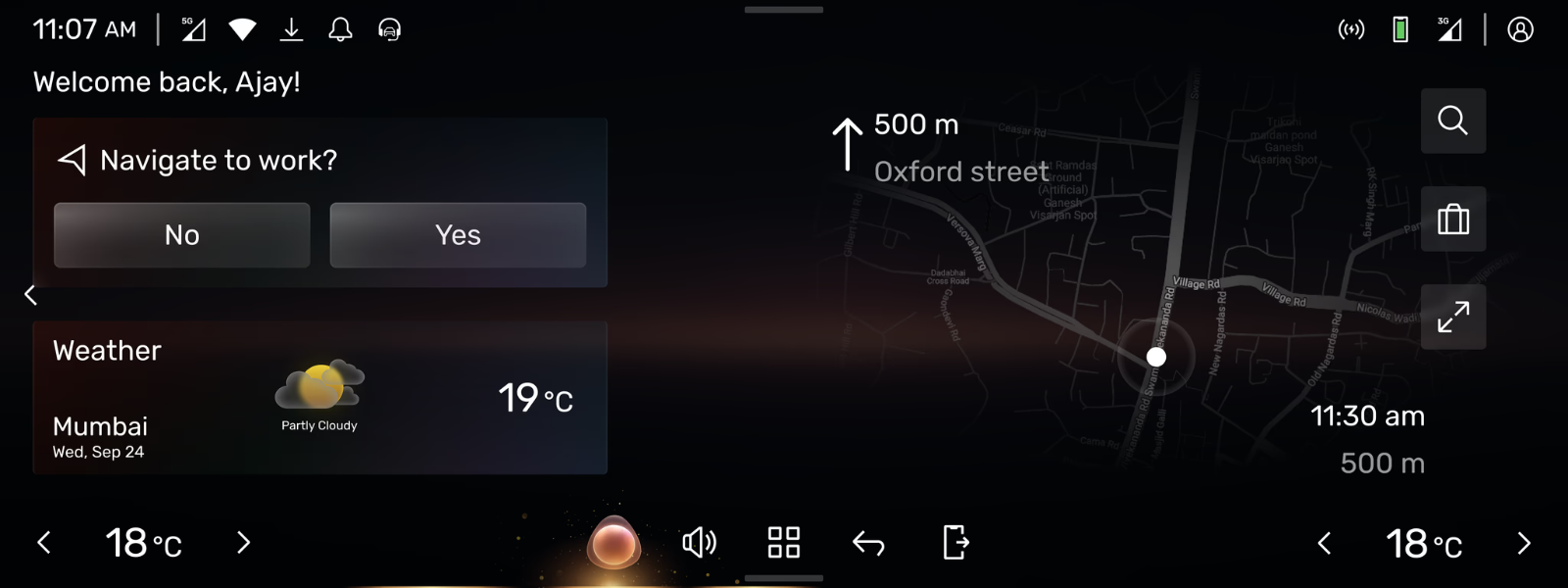
Navigating to Work Scenario

AI enables a state-aware, context-driven interface that continuously adapts from listening to navigating making system behavior transparent and predictable. By using ambient feedback and progressive disclosure, it minimizes cognitive load, allowing the driver to stay focused while still feeling informed and in control. The result is a high-trust, low-effort experience that improves safety, accuracy, and overall driving delight.

AI enables a state-aware, context-driven interface that continuously adapts from listening to navigating making system behavior transparent and predictable. By using ambient feedback and progressive disclosure, it minimizes cognitive load, allowing the driver to stay focused while still feeling informed and in control. The result is a high-trust, low-effort experience that improves safety, accuracy, and overall driving delight.

Dormant

Dormant

Thinking

Thinking

Dormant

Speaking

Speaking

Dormant/Listening

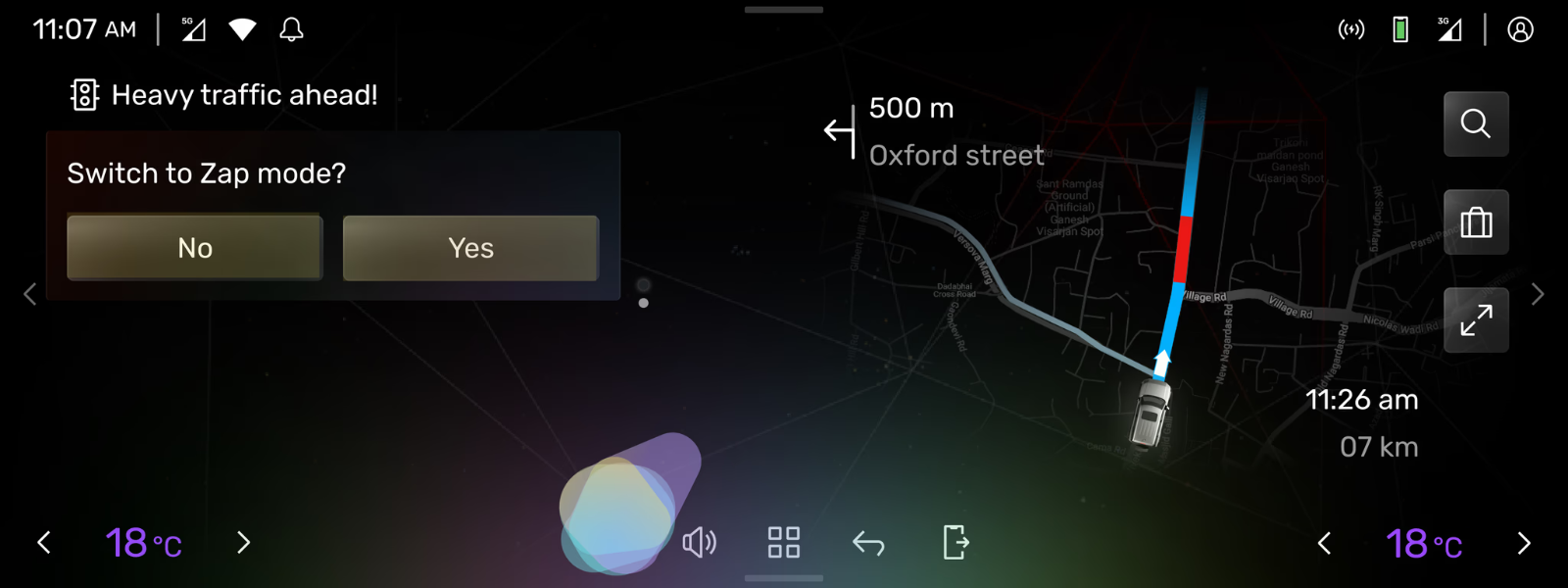
Heavy Traffic Scenario

In the heavy traffic scenario, AI focuses on proactive decision support and adaptive guidance, surfacing timely interventions like reroutes or mode switches as conditions change. The system uses confidence-based communication (clear, assertive prompts when certainty is high) and reduced interaction friction (quick yes/no actions), helping the driver make fast, low-effort decisions turning a stressful situation into a more controlled, manageable experience.

In the heavy traffic scenario, AI focuses on proactive decision support and adaptive guidance, surfacing timely interventions like reroutes or mode switches as conditions change. The system uses confidence-based communication (clear, assertive prompts when certainty is high) and reduced interaction friction (quick yes/no actions), helping the driver make fast, low-effort decisions turning a stressful situation into a more controlled, manageable experience.

Dormant

Dormant

Thinking

Thinking

Dormant

Dormant

Speaking

Speaking

Speaking

Speaking

Dormant/Listening

Dormant/Listening

Heavy Rain Scenario
Heavy Rain Scenario
Heavy Rain Scenario

In the heavy traffic scenario, AI focuses on proactive decision support and adaptive guidance, surfacing timely interventions like reroutes or mode switches as conditions change. The system uses confidence-based communication (clear, assertive prompts when certainty is high) and reduced interaction friction (quick yes/no actions), helping the driver make fast, low-effort decisions - turning a stressful situation into a more controlled, manageable experience.

In the heavy traffic scenario, AI focuses on proactive decision support and adaptive guidance, surfacing timely interventions like reroutes or mode switches as conditions change. The system uses confidence-based communication (clear, assertive prompts when certainty is high) and reduced interaction friction (quick yes/no actions), helping the driver make fast, low-effort decisions - turning a stressful situation into a more controlled, manageable experience.

Dormant

Dormant

Thinking

Thinking

Thinking

Thinking

Speaking

Speaking

Thinking

Thinking

Speaking

Speaking

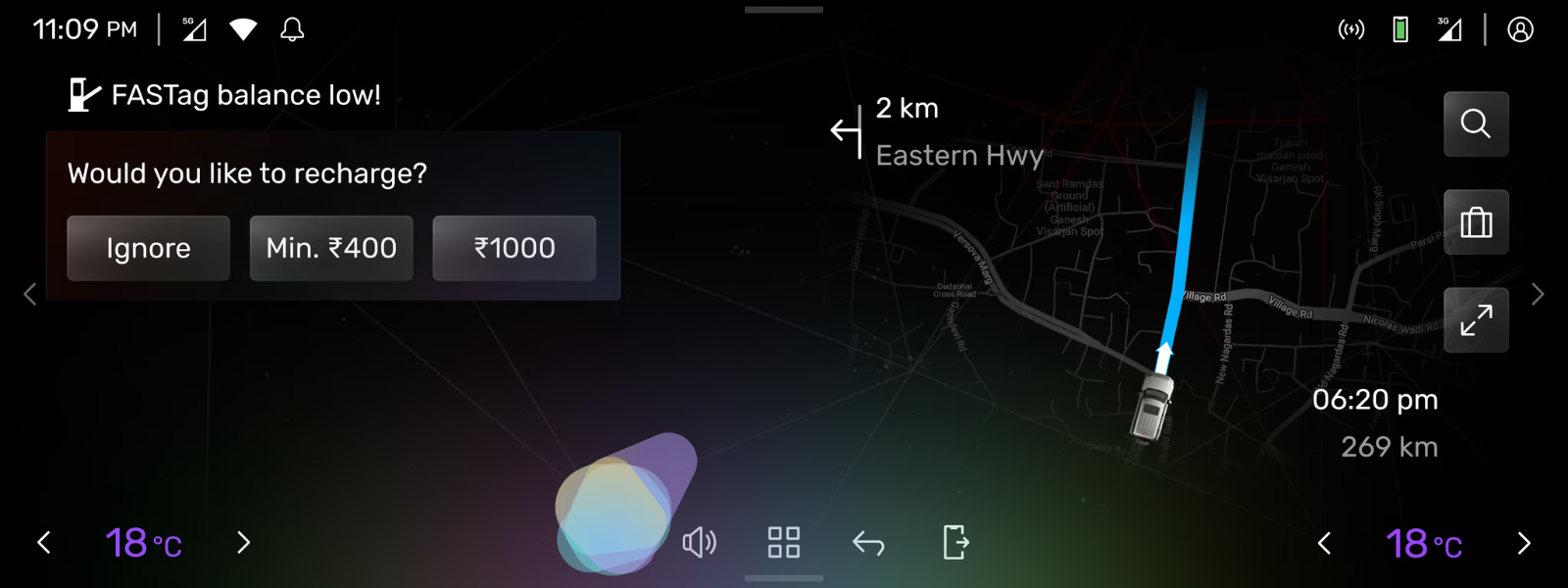
Approaching Toll Booth

In the approaching toll booth scenario, MAIA enables anticipatory automation by detecting the toll in advance and preparing payment or access options before the driver needs to act. Through frictionless confirmation and seamless handoff (e.g., auto-pay success states), it minimizes interaction at a critical moment ensuring a smooth, uninterrupted driving flow.

In the approaching toll booth scenario, MAIA enables anticipatory automation by detecting the toll in advance and preparing payment or access options before the driver needs to act. Through frictionless confirmation and seamless handoff (e.g., auto-pay success states), it minimizes interaction at a critical moment ensuring a smooth, uninterrupted driving flow.

Dormant

Speaking

Thinking

Speaking

Dormant

Dormant

Thinking

Thinking

Dormant

Speaking

Thinking

Speaking

Camp Mode
Camp Mode
Camp Mode

Dormant

Dormant

Thinking

In the approaching toll booth scenario, MAIA enables anticipatory automation by detecting the toll in advance and preparing payment or access options before the driver needs to act. Through frictionless confirmation and seamless handoff (e.g., auto-pay success states), it minimizes interaction at a critical moment ensuring a smooth, uninterrupted driving flow.

In the approaching toll booth scenario, MAIA enables anticipatory automation by detecting the toll in advance and preparing payment or access options before the driver needs to act. Through frictionless confirmation and seamless handoff (e.g., auto-pay success states), it minimizes interaction at a critical moment ensuring a smooth, uninterrupted driving flow.

Dormant

Dormant

Listening

Listening

Thinking

Thinking

Iteration 1
Iteration 1
Iteration 1

Dormant

Dormant

Thinking

Thinking

We didn’t take this forward because the orb-based agent, while expressive, lacked precision and clarity for high-stakes driving contexts - users couldn’t always interpret what the system was doing or how to act. It also competed subtly with primary navigation information, making the experience feel more aesthetic than functional, whereas the final direction prioritizes clearer, more actionable communication of AI intent.


We didn’t take this forward because the orb-based agent, while expressive, lacked precision and clarity for high-stakes driving contexts—users couldn’t always interpret what the system was doing or how to act. It also competed subtly with primary navigation information, making the experience feel more aesthetic than functional, whereas the final direction prioritizes clearer, more actionable communication of AI intent.


We didn’t take this forward because the orb-based agent, while expressive, lacked precision and clarity for high-stakes driving contexts - users couldn’t always interpret what the system was doing or how to act. It also competed subtly with primary navigation information, making the experience feel more aesthetic than functional, whereas the final direction prioritizes clearer, more actionable communication of AI intent.


We didn’t take this forward because the orb-based agent, while expressive, lacked precision and clarity for high-stakes driving contexts - users couldn’t always interpret what the system was doing or how to act. It also competed subtly with primary navigation information, making the experience feel more aesthetic than functional, whereas the final direction prioritizes clearer, more actionable communication of AI intent.


Dormant

Dormant

Listening

Listening

Thinking

Thinking

Speaking

Speaking

Iteration 2
Iteration 2
Iteration 2

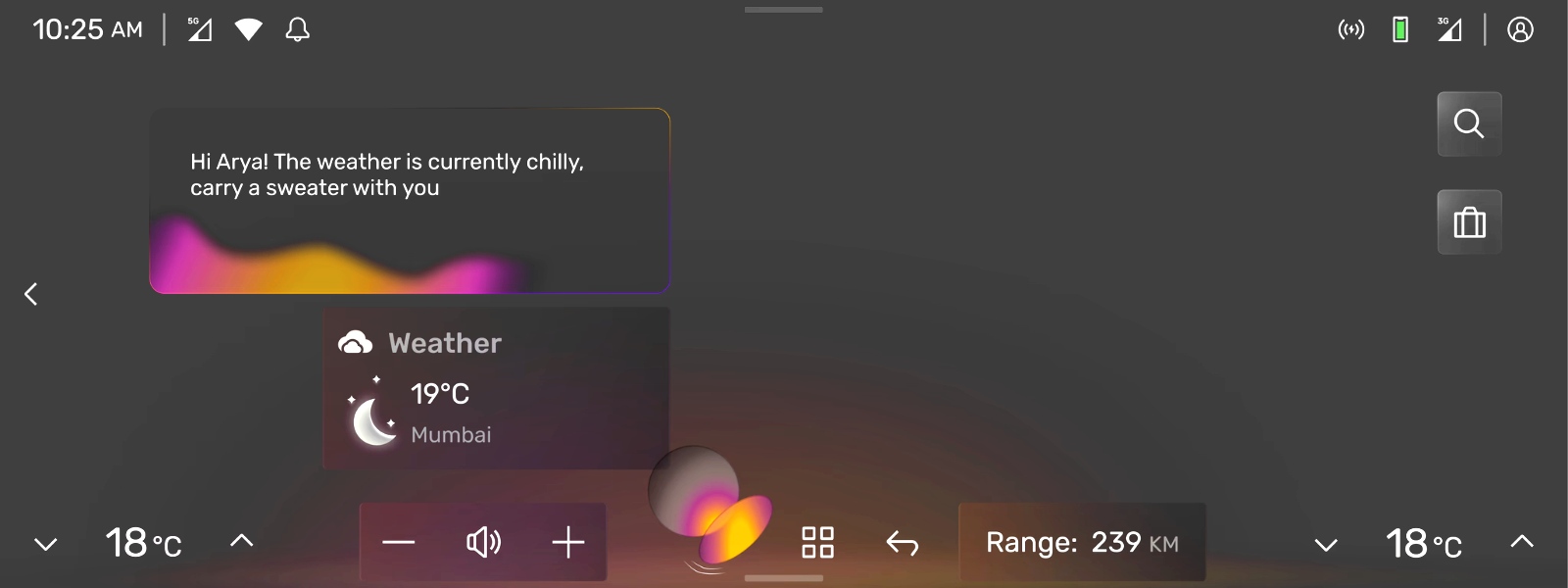
The bottom agent uses a soft, gradient color system that shifts across states - warmer, brighter tones for active states (listening/responding) and cooler, muted tones for passive ones making state changes instantly perceivable without text. The glow and diffusion of color create an ambient presence rather than a sharp UI element, ensuring it feels integrated into the environment while subtly drawing attention only when needed.


We didn’t take this forward because the orb-based agent, while expressive, lacked precision and clarity for high-stakes driving contexts—users couldn’t always interpret what the system was doing or how to act. It also competed subtly with primary navigation information, making the experience feel more aesthetic than functional, whereas the final direction prioritizes clearer, more actionable communication of AI intent.


The bottom agent uses a soft, gradient color system that shifts across states - warmer, brighter tones for active states (listening/responding) and cooler, muted tones for passive ones making state changes instantly perceivable without text. The glow and diffusion of color create an ambient presence rather than a sharp UI element, ensuring it feels integrated into the environment while subtly drawing attention only when needed.


Dormant

Dormant

Thinking

Thinking

Dormant

Dormant

Listening

Listening

Dormant

Dormant

Listening

Listening