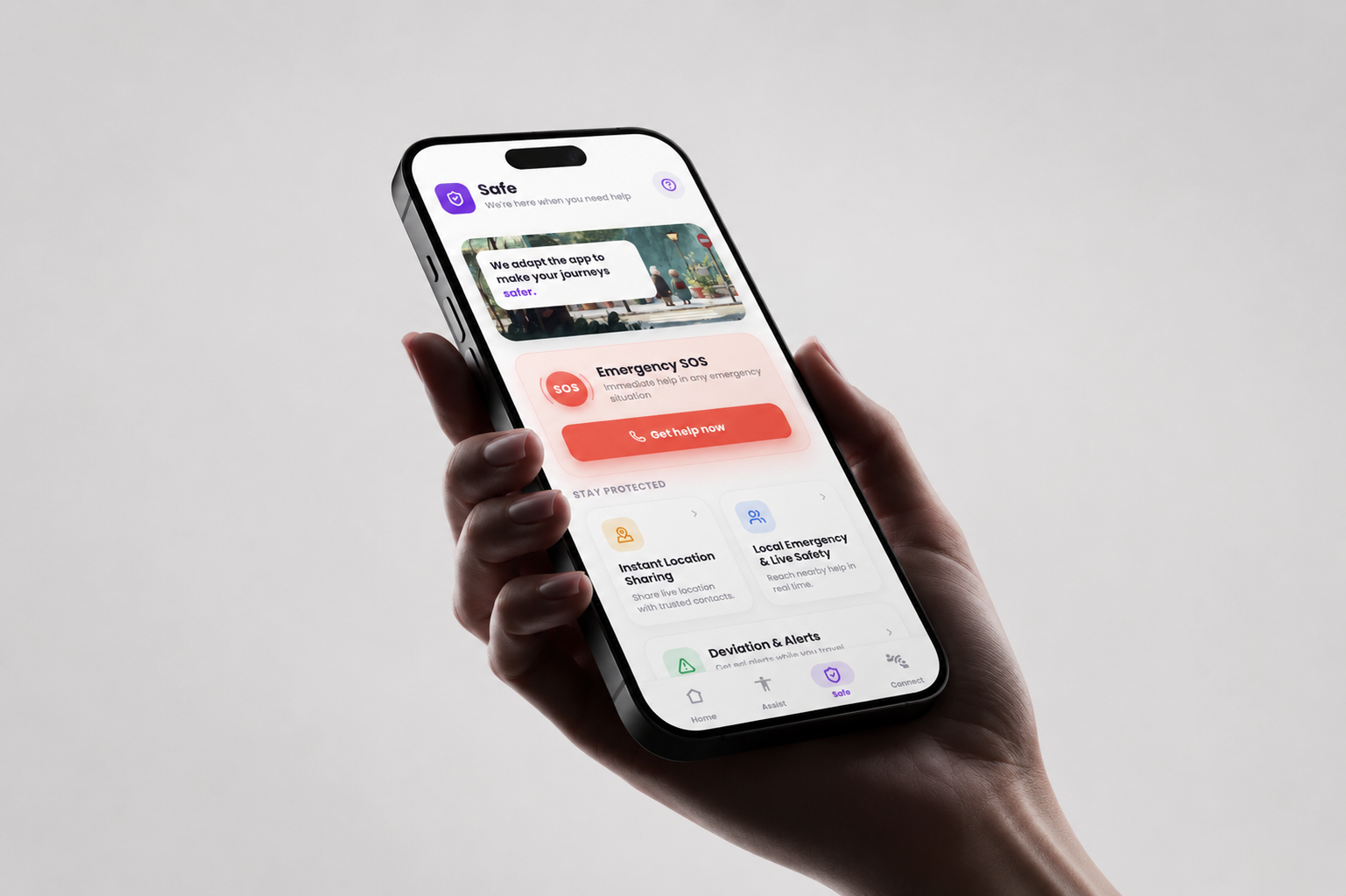
Mobility is not a routing problem. It's a confidence problem.
This self-initiated project treats mobility as a systems challenge shaped by ageing and independence. Research revealed how physical, cognitive, and emotional factors, combined with distance from family, shape how older adults navigate and decide whether to travel at all.
I designed experiences that enable independent travel while supporting family collaboration, shifting mobility from an individual task to a connected experience, measured through trip completion, user confidence, and shared planning.
The trip is decided long before the app opens.
At 9:30 PM, a 62-year-old prepares to leave a family gathering. She pauses, not at the door, but mentally. Before stepping out, she runs a quiet calculation:
- Is the route familiar enough?
- Will it feel safe at this hour?
- What if something goes wrong, can I handle it alone?
She hasn't opened a navigation app yet. But the decision to travel has already been made, or abandoned.
Thesis
Mobility systems are built on a flawed assumption: that navigation is an individual, deterministic task. For older adults, mobility is actually:
- Probabilistic, things go wrong.
- Contextual, the environment matters more than the map.
- Distributed, decisions are shared with family.
This project reframes mobility from a routing problem into a confidence system operating across people, time, and uncertainty.
Three modes of inquiry, from macro root-causes to micro decisions.
The research combined systems thinking with design thinking, so macro-level root causes translated cleanly into micro-level design decisions.

Strategic intelligence
Secondary research to map the domain, market gaps, and systemic root causes before any fieldwork.

Human insight
In-depth interviews and expert consultations using purposive + snowball sampling for genuine diversity.

Design execution
System maps, empathy maps, and personas translating multi-layered insight into design direction.
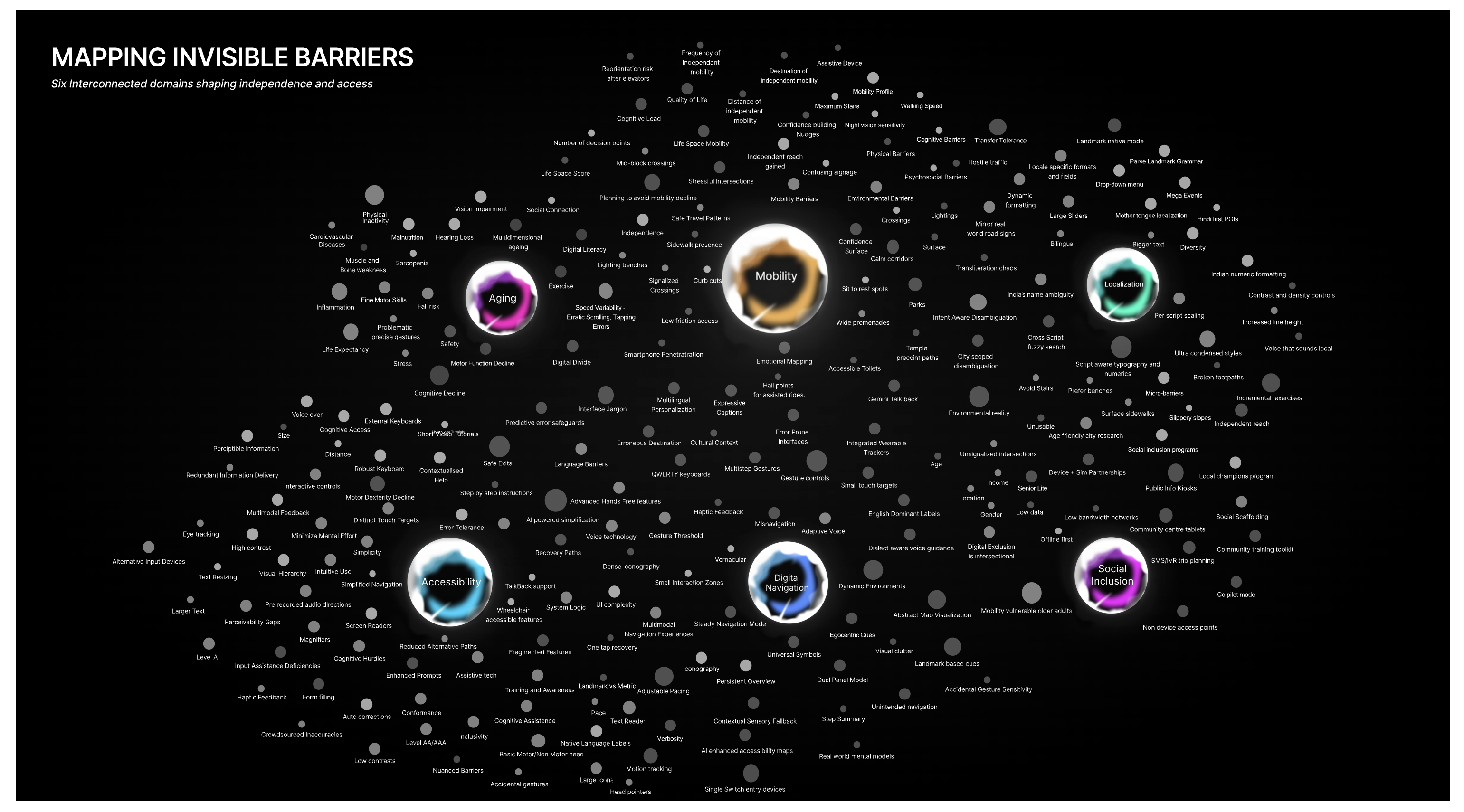
Reframing the problem, five failure domains
Abandoned journeys rarely trace back to a single cause. Five failure modes compound on one another:
Behavioural
Users abandon journeys not from inability, but hesitation.
Environmental
Poor lighting, broken sidewalks, unsafe crossings.
Trust
A single wrong instruction leads to long-term disengagement.
Cognitive
High information density meets declining processing ability.
Social
Family support exists, but is never integrated.
Pain points, in their own words.
"In Goa, around 2 AM, our cab followed the map to the wrong location despite the correct address, leaving us stranded on an isolated street. It felt really unsafe."
Interview participant, 58"If my eyesight worsens I'd rely more on audio, but using audio and visuals together drains the battery fast, especially on a basic phone."
Interview participant, 64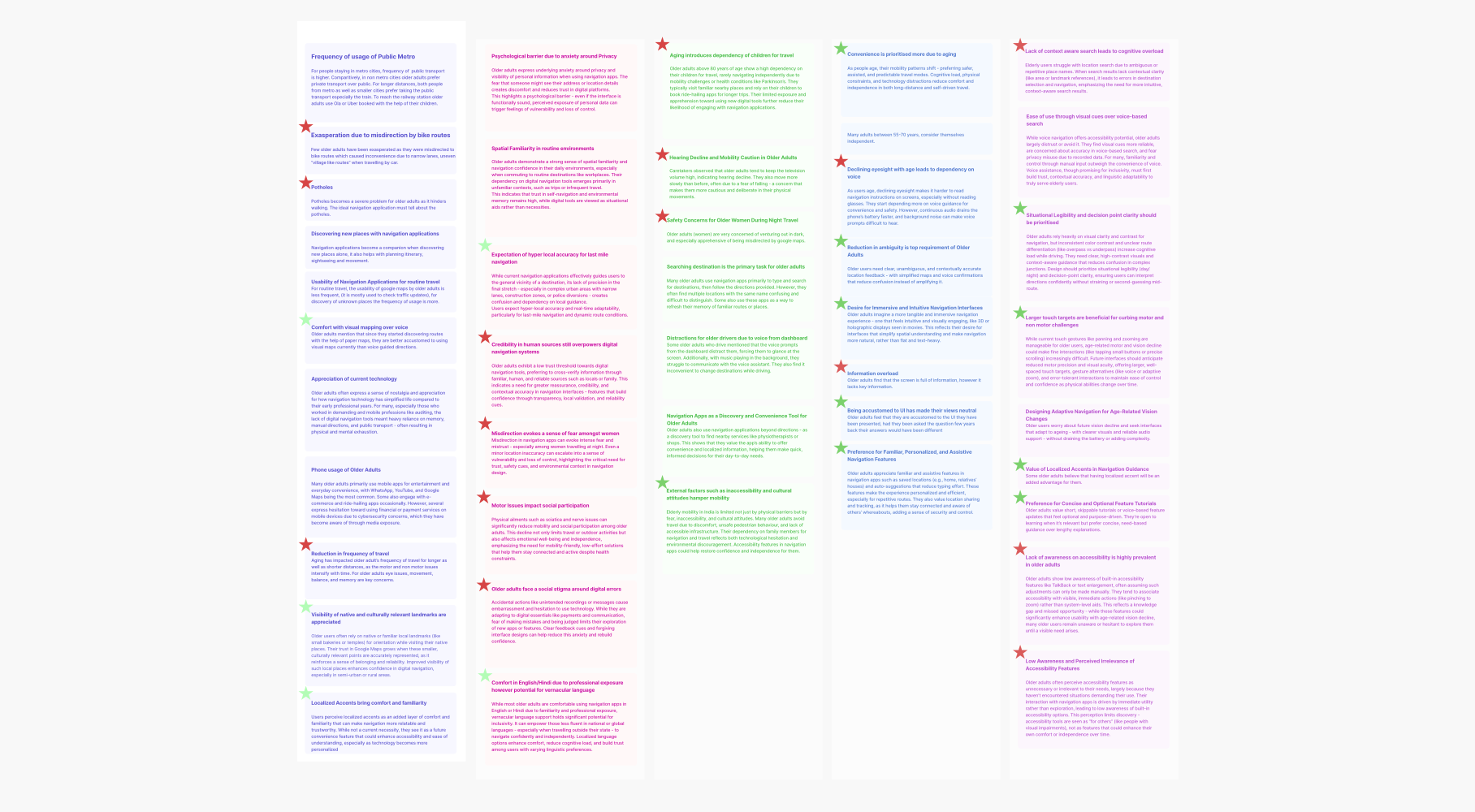
Four insights that reframed everything
Ageing is compounded, not singular
Physical, cognitive, and emotional changes overlap. Apps fix one impairment at a time, missing how challenges compound in a real journey.
Mobility is a family activity
Family networks act as co-decision-makers. Travel choices are rarely made alone, yet the tools assume they are.
Trust doesn't fail from errors
One mistake becomes a lasting barrier when there's no reassurance and no path back to confidence.
The environment is navigation
Feasibility depends on sidewalks, seating, shade, safe crossings, affordances no map accounts for.
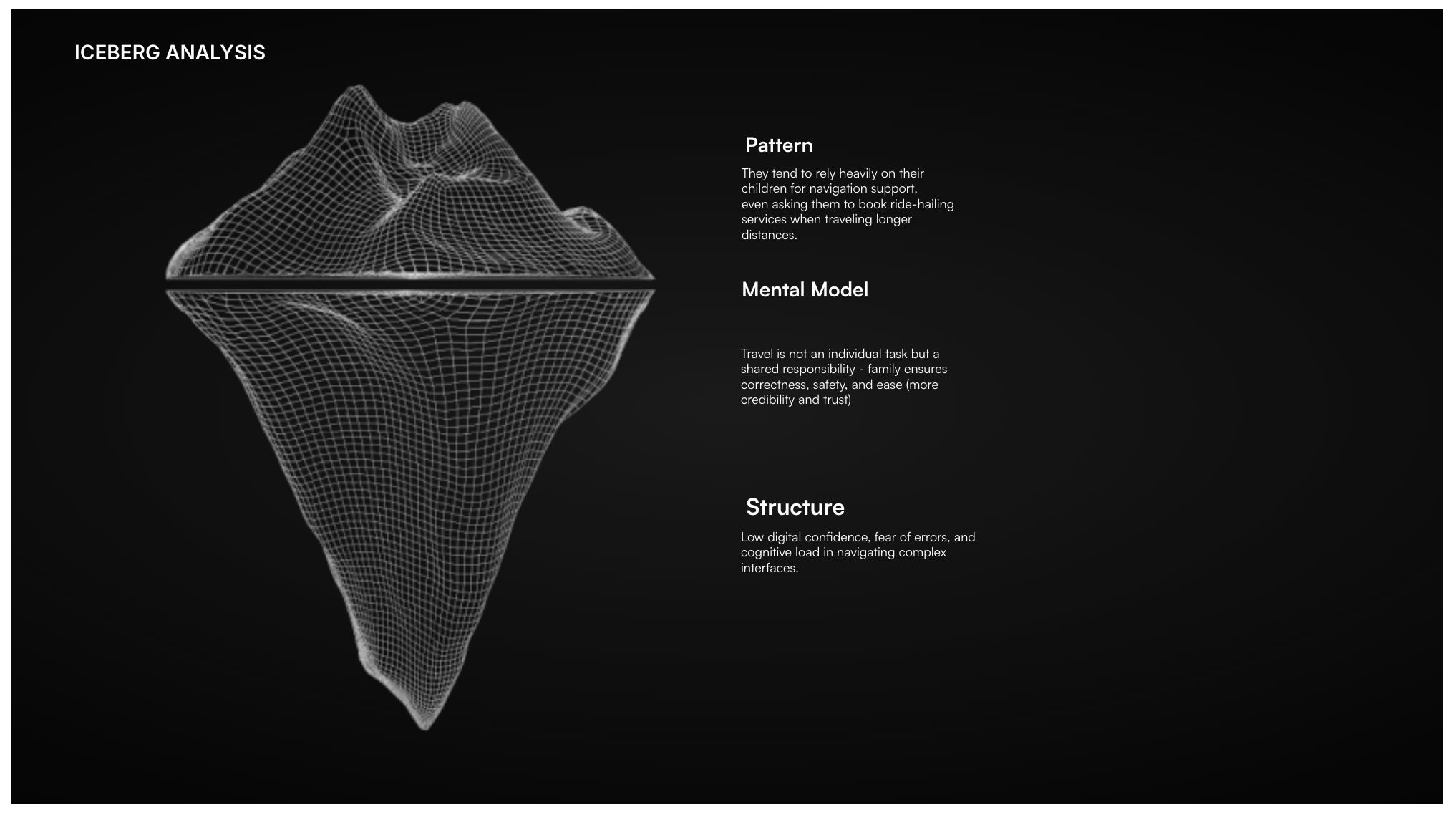
Iceberg analysis
Surfacing the structure beneath the behaviour we observed.
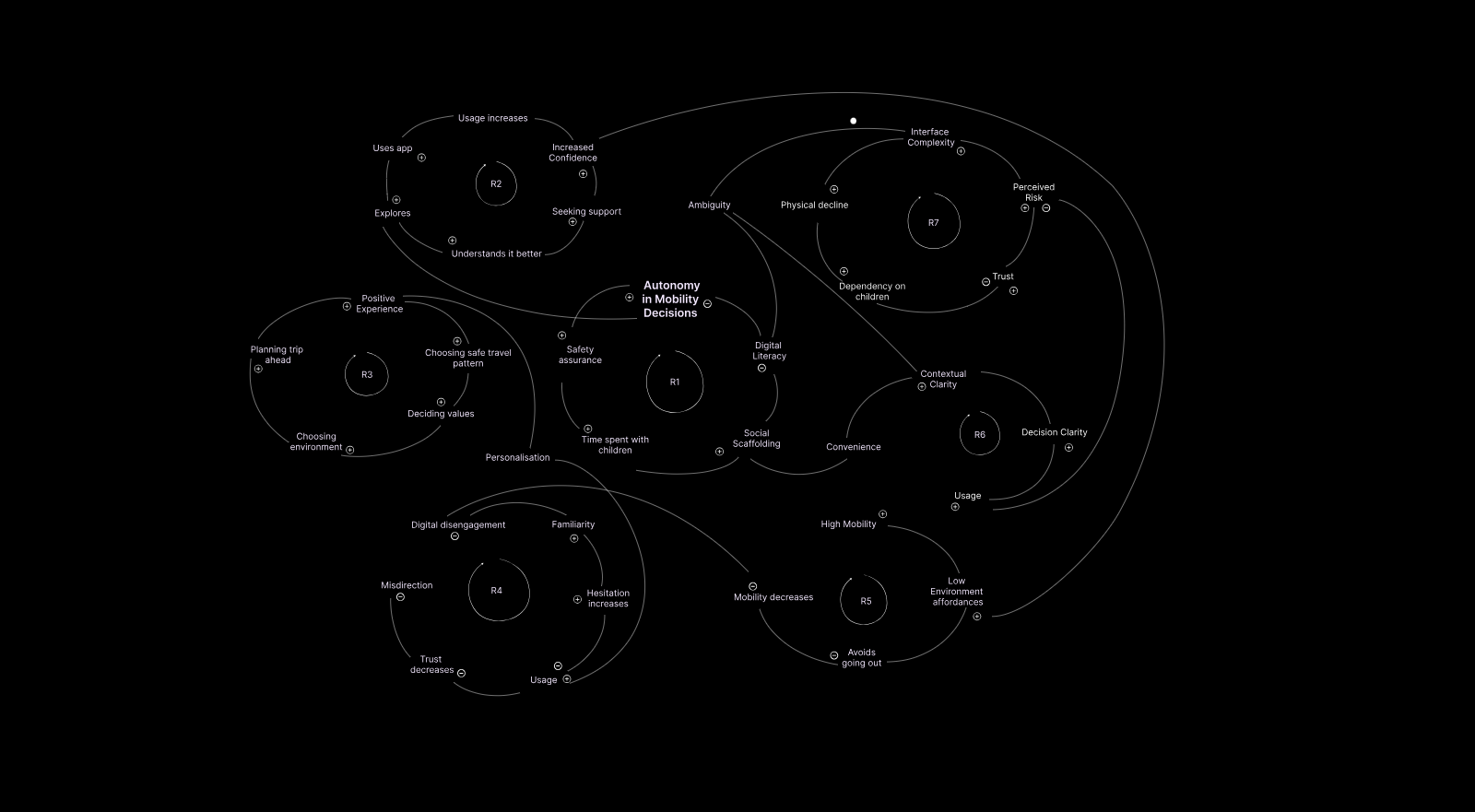
Where today's systems quietly fail older adults.
Older adults don't optimise for speed or efficiency. They optimise for predictability, familiarity, and perceived safety.
Instructions optimise for efficiency, not comprehension
Turn-by-turn density assumes fast processing the user may not have.
Safety anxiety is invisible to the system
Fear, especially for older women in unfamiliar areas, is never recognised or addressed.
Decisions are rarely made in isolation
Family act as implicit co-decision-makers, but systems enforce a solo model.
Accessibility is static; needs are dynamic
Participants had assistive features but used them inconsistently as context shifted.
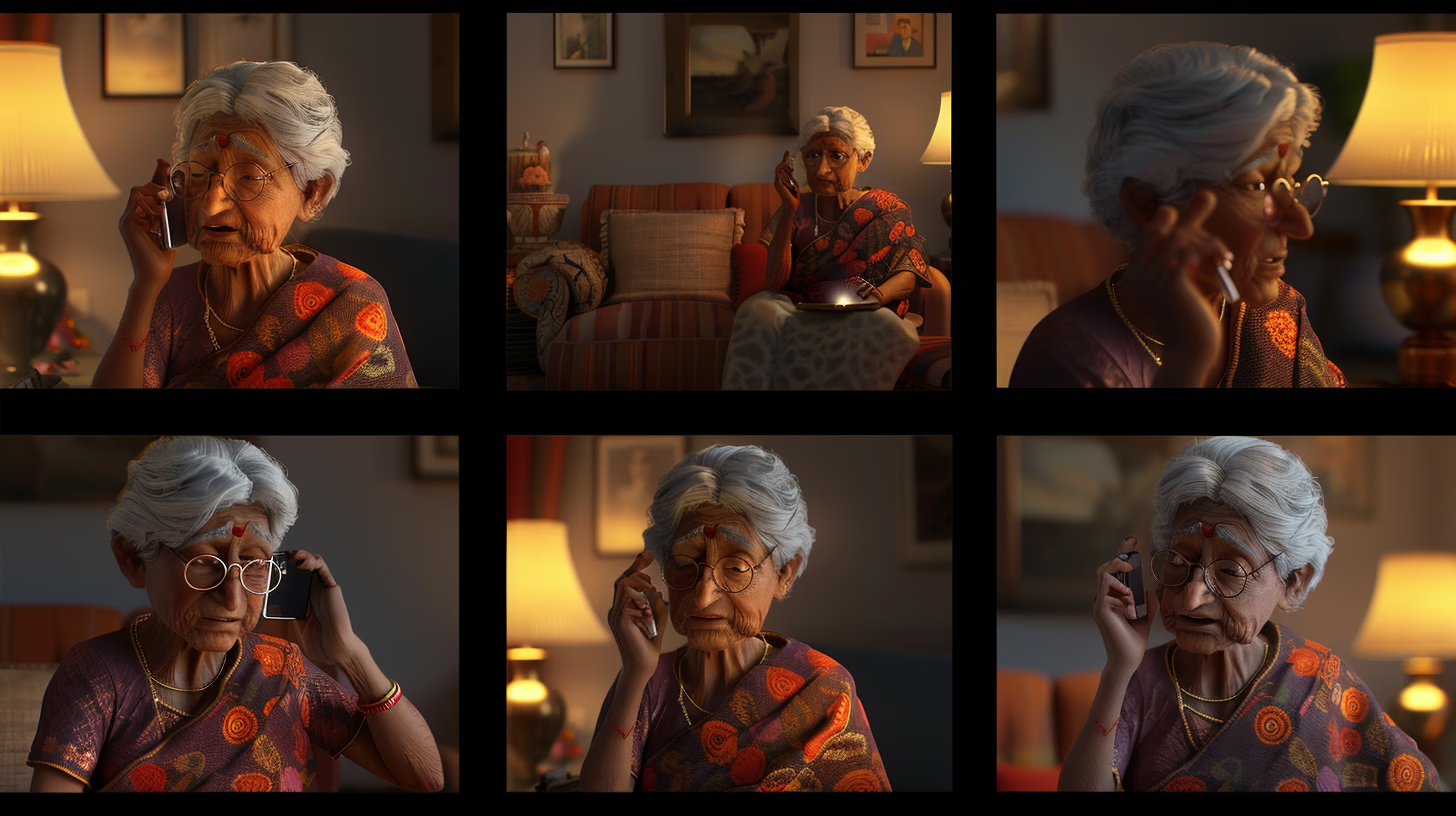
Three reframes to design toward.
How might we help older adults recover from uncertainty mid-journey, without losing confidence or control?
How might we preserve independence while integrating family as a passive support layer at critical moments?
How might we shift navigation from accurate directions to continuously reinforcing confidence?
The principles the product had to embody.

Recoverable trust
Design for reassurance, safe fallback, and confidence recovery. Trust shouldn't depend on perfection, it should survive failure.

Adaptive perception
Design for multimodal, context-aware interaction. Interfaces should flex to human limits, not the other way around.

Collaboration
Design for distributed decisions and invisible support. Independence is enabled by support, not the absence of it.
Confidence, designed across the whole journey.
Instead of route optimisation
- Landmark-based previews
- Familiarity prioritised over efficiency
- Collaborative planning with family
From instructions → validation
- "You're on the right path" signals
- Context-aware cues, not step-by-step overload
- Adaptive multimodal feedback
Instead of "Recalculating…"
- Safe fallback points, known, trusted places
- Human-readable recovery steps
- Escalation paths that notify family when needed
Reinforce the win
- Reinforce successful journeys
- Reduce hesitation in future decisions
Speed was the wrong metric. So I designed a new one.
Traditional KPIs, speed, route accuracy, miss the point. This project introduced the Life-Space Score: a 0–120 index of distance, frequency, and independence of real-world movement. A rising score signals quality of life, not task completion.
We equate independence with the absence of support. In reality, independence emerges when support is reliable, ambient, and unobtrusive.
The future of mobility isn't getting people from A to B faster. It's ensuring they never feel lost while getting there.